The Evolution of Video Games (1958–2020s)

Video games have evolved from simple electronic experiments into a worldwide entertainment industry. Over the decades, technological advances have transformed video games through arcade machines, home consoles, 3D graphics, online multiplayer, mobile devices, and immersive gaming experiences. This timeline highlights the most important events, creators, and games that shaped the history of the video game industry.

1

2020s–Present — Cross-Platform, Cloud, and Immersive Gaming

Examples: Fortnite, Minecraft, Roblox, and virtual reality games.

Modern gaming brings together consoles, computers, smartphones, and portable devices. Cross-platform multiplayer allows people using different systems to play together, while cloud gaming and virtual reality offer additional ways to access and experience games. The industry continues to explore new technologies and interactive experiences.

2

2020 — PlayStation 5 and Xbox Series X|S

Companies: Sony and Microsoft.

The PlayStation 5 and Xbox Series X|S introduced a new console generation with faster storage, improved visual performance, and more immersive experiences. Online subscriptions, digital libraries, and multiplayer services also became increasingly important to the gaming experience.

3

2017 — The Nintendo Switch and Fortnite Battle Royale

Companies: Nintendo and Epic Games.

The Nintendo Switch combined home-console gaming with portable play, allowing users to move between television and handheld modes. In the same year, Fortnite Battle Royale popularized a highly social, continuously updated multiplayer experience that helped shape the modern live-service gaming model.

4

2013 — PlayStation 4 and Xbox One

Companies: Sony and Microsoft.

The PlayStation 4 and Xbox One strengthened the role of online services, digital game distribution, social features, and high-definition graphics. Gaming increasingly connected players through downloads, multiplayer modes, and online communities.

5

2007–2009 — The Growth of Mobile Gaming

Companies: Apple and Rovio Entertainment. Example game: Angry Birds.

Smartphones and app stores opened new opportunities for mobile games. Angry Birds, released by Rovio in 2009, became a major example of how touchscreen controls and short, accessible gameplay could reach millions of players.

6

2006 — The Nintendo Wii and Motion Controls

Company: Nintendo.

The Nintendo Wii introduced motion-sensitive controls that allowed players to interact with games through physical movements. Games such as Wii Sports attracted families and casual players, showing that gaming did not have to rely only on traditional controllers.

7

2004 — World of Warcraft and Online Gaming Communities

Developer: Blizzard Entertainment.

World of Warcraft allowed players to explore a persistent fantasy world, complete missions, join guilds, and cooperate with other people online. Its success demonstrated the potential of massively multiplayer online role-playing games (MMORPGs) to create lasting social communities.

8

2000 — The PlayStation 2

Company: Sony Computer Entertainment.

The PlayStation 2 expanded home gaming through improved 3D graphics, a large library of games, and DVD playback. Its commercial success helped make consoles a central part of mainstream entertainment.

9

1996 — Super Mario 64 and Three-Dimensional Gaming

Company: Nintendo. Platform: Nintendo 64.

Super Mario 64 brought Mario into a fully three-dimensional world. Its open environments, camera controls, and freedom of movement helped establish important design principles for 3D platform games.

10

1994–1995 — The Launch of PlayStation

Company: Sony Computer Entertainment.

The original PlayStation launched in Japan in December 1994 and in North America and Europe in 1995. Its use of CD-ROMs supported larger games, detailed audio, cinematic sequences, and increasingly sophisticated 3D experiences.

11

1989 — The Game Boy and Tetris

Companies: Nintendo and Bullet-Proof Software, among others. Game creator: Alexey Pajitnov.

Nintendo's Game Boy made portable gaming accessible to a large audience. Tetris, a puzzle game based on arranging falling blocks, became one of its best-known titles and demonstrated that simple, addictive gameplay could succeed on handheld devices.

12

1985 — The Nintendo Entertainment System and Super Mario Bros.

Creator of Super Mario Bros.: Shigeru Miyamoto and the Nintendo development team. Company: Nintendo.

The Nintendo Entertainment System (NES) helped revive the North American home console market. Super Mario Bros. became a landmark platform game through its side-scrolling levels, precise controls, secrets, and memorable characters.

13

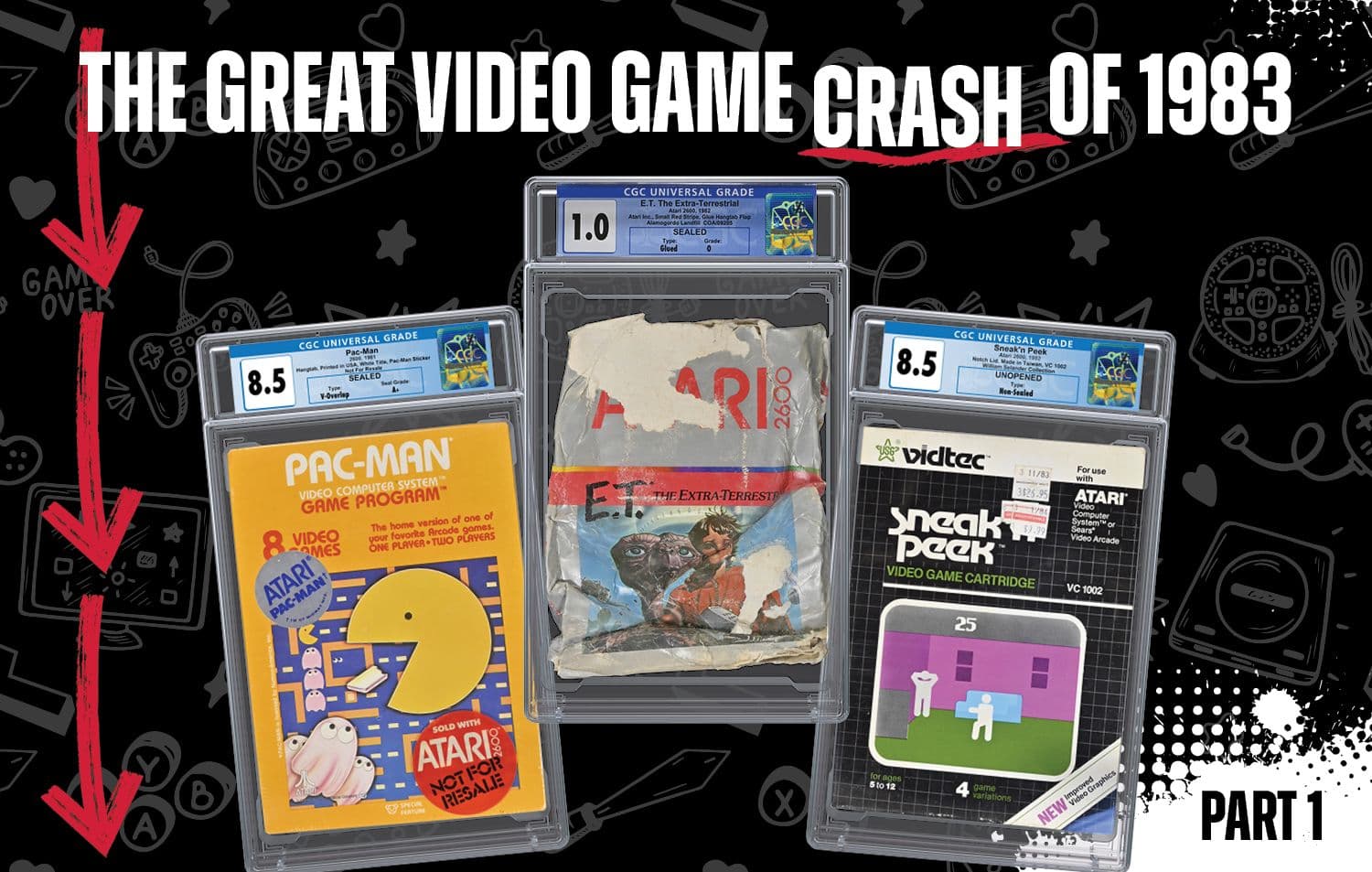
1983 — The North American Video Game Crash

Industry event: Declining sales and market oversaturation.

The North American video game industry experienced a major crisis because of an oversaturated market, intense competition, and an abundance of poorly received games. The crisis weakened several companies and changed how games were developed, marketed, and distributed.

14

1981 — Donkey Kong

Creator: Shigeru Miyamoto. Company: Nintendo.

Donkey Kong introduced players to a character originally called Jumpman, who later became known as Mario. The game combined jumping, obstacles, and a simple narrative, helping establish important ideas used in platform games.

15

1980 — Pac-Man

Creator: Toru Iwatani. Company: Namco.

Pac-Man introduced a recognizable yellow character navigating a maze while collecting dots and avoiding ghosts. Its original gameplay, colorful characters, and appeal to a broad audience made it one of the most iconic games in history.

16

1978 — Space Invaders

Creator: Tomohiro Nishikado. Company: Taito.

Space Invaders was a successful arcade shooting game in which players defended Earth against waves of alien invaders. Its increasing difficulty, high-score system, and memorable enemies helped make arcade gaming a major cultural phenomenon.

17

1977 — The Atari 2600

Company: Atari.

The Atari 2600 popularized home gaming with interchangeable game cartridges. Instead of buying a different machine for every game, players could use one console to enjoy many different titles, helping video games become a regular part of home entertainment.

18

1972 — Pong and the Rise of Arcade Gaming

Creator: Allan Alcorn. Company: Atari, founded by Nolan Bushnell and Ted Dabney.

Pong was a simple table-tennis arcade game in which players moved paddles to hit a ball. Its popularity helped establish the commercial arcade video game industry and inspired many similar games.

19

1972 — The Magnavox Odyssey

Designer: Ralph Baer and his development team. Company: Magnavox.

The Magnavox Odyssey became the first commercial home video game console. It allowed people to play simple electronic games on their television sets, marking an important step toward bringing video games into people's homes.

20

1962 — Spacewar!

Creator: Steve Russell and collaborators at the Massachusetts Institute of Technology (MIT).

Spacewar! was a computer game in which two players controlled spaceships and attempted to destroy each other. It ran on the PDP-1 computer and became an influential early example of interactive computer gaming.

21

1958 — Tennis for Two

Creator: William Higinbotham, with technical assistance from David Potter.

Tennis for Two was an early interactive electronic game displayed on an oscilloscope. It simulated a tennis match between two players and demonstrated that computers could be used for entertainment, not only scientific research.

The Evolution of Video Games (1958–2020s)